

Thursday, March 14, 2013


Tuesday, December 18, 2012

Sunday, December 9, 2012
Hindsight
Hindsight.
While preparing dinner one evening, after playing Christmas CD roulette, while listening to, “Christmas Alleluia” by the Choirs of All Saints Episcopal Church, in Atlanta, Georgia, I made a realization. Ray and Beth Chenault Organist/Choirmasters. (http://www.towerhill-recordings.com/ChristmasAlleluia.html)

This recording features wonderful performances by the
choirs, instrumentalists and the always steady, driven playing of the Chenault
duo. Made in 2001, this recording also serves as a glimpse back at the 1971
Keenan Memorial Organ, by the Schantz Organ Company of Orrville, Ohio. I
participated in the successful relocation of this three manual organ to Christ
Church (Episcopal), in Valdosta, Georgia.
The ability to listen to an instrument that preceded the
Buzard organ we now curate is enlightening. How often in conversation today, do
you hear an organist refer to a pipe organ from the 1970’s with positive
adjectives? As stylistic and tonal desires change, I fear it is too easy to become
quickly dismissive of whatever we have decided is now, passé.
When listening to this organ with a critical ear, I hear a dozen or more things that as a builder and voicer would do differently. Listing those items here would be very easy, but that would not be productive to the point being made. There are things I like about the organ as well to be honest. The 16’ Gamba in the Pedal, whose pipes are from the Roosevelt organ that preceded the Schantz at All Saints is just delightful. Warm and purry like a happy tiger. The 8’ Holz Gedeckt in the Positiv (with cherry fronts), is cheerful and bright, but also retains a very nice warmth.
When listening to this organ with a critical ear, I hear a dozen or more things that as a builder and voicer would do differently. Listing those items here would be very easy, but that would not be productive to the point being made. There are things I like about the organ as well to be honest. The 16’ Gamba in the Pedal, whose pipes are from the Roosevelt organ that preceded the Schantz at All Saints is just delightful. Warm and purry like a happy tiger. The 8’ Holz Gedeckt in the Positiv (with cherry fronts), is cheerful and bright, but also retains a very nice warmth.
Here is the point.
Our current tastes in organ nationalistic styles of tonal design
that are very different from those of 1971, has no bearing on the musicians in
this recording making wonderful music. Keep in mind this is an instrument they
oversaw the replacement of by the very fine, but very different John-Paul
Buzard pipe organ. This recording proves that in the hands of fine musicians,
the pipe organ is an Instrument (a means whereby something is achieved,
performed, or furthered).
Regardless of musical styles, fine musicians are able to
produce fine results on organs of many varying styles and types. Cleverness and
creativity allow them to work with the resources at hand to convey the musical
message. When we remember the pipe organ is only an instrument for the
musician, it helps grant perspective.
We should be less dismissive of pipe organs whose styles may have come and gone. That very mindset robbed us of so many fine organs by: Roosevelt, Kimball, Skinner, Hutchings, Schlicker, Pilcher, Kilgen, etc. While each musician and organization have to make the best decisions they can for the requirements of their project, I would hope as musicians. artisans, and craftsmen can retain objectivity and be more able to say, “That’s good! It’s not anything I would do today, but man that is GOOD!”
We should be less dismissive of pipe organs whose styles may have come and gone. That very mindset robbed us of so many fine organs by: Roosevelt, Kimball, Skinner, Hutchings, Schlicker, Pilcher, Kilgen, etc. While each musician and organization have to make the best decisions they can for the requirements of their project, I would hope as musicians. artisans, and craftsmen can retain objectivity and be more able to say, “That’s good! It’s not anything I would do today, but man that is GOOD!”
The untraceable quote of, “There are only two kinds of
music; good and bad,” should also be able to apply to pipe organs.
Robert I. Coulter, Jr.
(c) 2012 / All Rights Reserved
Tuesday, October 23, 2012
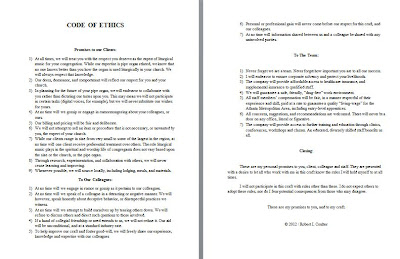
Code of Ethics
As we are fortunate to grow, and to have the great pleasure to work with so many fine musicians and pipe organs, it's time to release our Code of Ethics.
These are the ethics and rules we hold ourselves to, and the rules we have held ourselves to for many years. Now is the time to put these in writing and release them to the pipe organ world.
We are honored to work in a field that ultimately helps uplift the spirits of congregants and music lovers. I believe that such work requires an upright and honest approach, and my company will not perform in any other manner.
Robert I. Coulter - President / Tonal Director

Sunday, October 21, 2012
University of Texas at Austin
Teaser photos from our restoration & relocation of Aeolian-Skinner Opus 1393. 

Friday, February 3, 2012
Wanted: Pipe Organ Builder/Technician
Pipe Organ Builder/Technician
Small reputable and growing company seeking an individual for a full-time position in the pipe organ industry. Seeking committed individual with a minimum of 2 years of training and experience in full time tuning and servicing of Pipe Organs. Must possess strong organizational skills, congenial personality and a desire for the best professional care. We require a good attitude and the drive to do high quality work. We have good fun while working and enjoy working with other happy people.
Wages and benefits would be based upon experience and a quality living-wage for the Atlanta, Georgia metro area. Please send your resume to: info@coulterorgans.com.
Robert I. Coulter - Organbuilders:
2233 Faulkner Road
Atlanta, GA 30324
404-931-3103
http://coulterorgans.com
Sunday, September 25, 2011
Decatur Presbyterian Church - New Console


We are pleased to announce the newly completed four manual console for Decatur Presbyterian Church. This console features quartersawn white oak, American black walnut, ebony and rosewood. 160 stops controlled by the IOTI Virtuoso system and keys with bone and ebony coverings. We are happy to present 'Amelia' to Decatur Presbyterian Church and the world.
Monday, March 14, 2011
South Highland Presbyterian Church
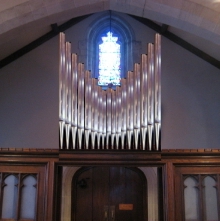
South Highland Presbyterian Church chapel - Birmingham, Alabama
The E. M. Skinner organ company built in 1926 its Opus 576 for the Ensley-Highland Presbyterian Church in Birmingham, Alabama. The instrument served this congregation, with some changes, until the church was closed by the Presbytery in 1991. The organ lanquished in a crumbling building until South Highland Presbyterian was afforded the ability to obtain the pipe organ. We were contracted by South Highland to remove this instrument to our shop and present a proposal to South Highland Presbyterian for its future.
The chapel at South Highland is one of considerable charm, and fine musicial potential. The current status of the electronic organ warranted its replacement. With the Skinner organ now in the possession of South Highland, it seemed a logical choice to install in the chapel. We were honored to have been contracted by South Highland to build a new chapel organ for them utilizing the Skinner organ as a resource.
Given the different requirements for installation, and the condition of the Skinner chests, new windchests will be built in a sympathetic style to those of E. M. Skinner. In this instrument, the existing console and keyboards will be retained. The Great organ will be located on the Gallery wall, along the center axis of the room for proper tonal egress. This division will feature a new Principal chorus of high content tin for a refined and elegant sound. The Swell and Pedal organs will be located in the chancel area. All the pipes, old and new, will reflect our belief that every pipe should speak with a rich, full sound that blends with others. It is sounds like these that best work with and support the human voice.
South Highland Presbyterian Church, Chapel
Robert I. Coulter - Organbuilders
Opus 9
Skinner Organ Company
Opus 576
II - 23
Great Organ
16' Lieblich Gedeckt
8' Principal (tin, en facade)
8' Chimney Flute (extension)
8' Salicional (Swell)
8' Voix Celeste (Swell)
4' Octave
4' Flute Harmonic (Swell)
2 2/3' Twelfth
2' Fifteenth
1 3/5' Seventeenth
III-IV - Mixture (1 1/3')
16' Contre Trompette
8' Trompette (extension)
8' Flugelhorn (Swell)
Tremulant
Swell Organ
8' Salicional
8' Voix Celeste (tenor c)
8' Aeoline
8' Aeoline Celeste (tenor c)
8' Gedeckt
4' Principal
4' Flute Harmonic
2 2/3' Nazard
2' Flautino
1 3/5' Tierce
8' Trompette (Great)
8' Flugelhorn
Tremulant
Pedal Organ
32' Resultant
16' Subbass
16' Lieblich Gedeckt (Great)
8' Octave
8' Bourdon (extension)
8' Gedeckt (Swell)
4' Choral Bass (extension)
4' Flute Harmonic (Swell)
16' Contre Trompette (Great)
8' Trompette (Great)
8' Flugelhorn (Swell)
Monday, January 10, 2011
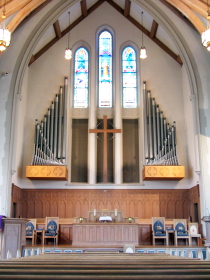
Decatur Presbyterian Church - Atlanta, Georgia
Beginning in 2004, we were asked by Organist-Choirmaster Matthew McMahan to care for the two Austin organs at Decatur Presbyterian Church. The sanctuary organ being from 1974 and of 58 ranks. An immediate concern was the rapid deterioration of the Austin console.
A plan was soon thereafter put forward for replacement of the Austin console with a new, four manual draw knob console. This console will feature the Integrated Organ Technologies Virtuoso control system. The white oak exterior will be finished and outfitted to both blend with and enhance the sanctuary. The console will also feature Syndyne draw knob units for an elegant feel, along with tracker touch keys.
Along with the plans for a console, we began working with Mr. McMahan for revisions and additions to the tonal scheme. The instrument, while effective in the performance of some literature, needed enhancement for choral accompaniment and even for congregational singing. To that end, limited digital voice additions were made in the 1990's in an attempt to round out the ensemble.
Working in complete conjunction with Mr. McMahan, we have devised a new specification, with additions and judicious revisions to existing resources to make an instrument that is eclectic, as well as versatile and suitable for any setting. As with all of our instruments, we strive for a cohesive ensemble sound that is made of individual stops of independent character, but that all strive for a relaxed, singing style. In this manner, different colors enhance rather than compete with each other, coming together into what we believe are exciting ensemble instruments.
Decatur Presbyterian Church
Austin Organ Company, Opus 2561
Robert I. Coulter - Organbuilders
Opus 8
IV - 87
| Great Organ Positiv Organ Pedal Organ | Swell Organ Choir Organ Gallery Organ (floating) |
Saturday, November 6, 2010
Trinity UMC, Spartanburg South Carolina
Trinity United Methodist Church - Spartanburg, South Carolina
Beginning in 2008, we were asked by Organist/Choirmaster Justin Addington to care for the 1988 Moller pipe organ installed at Trinity United Methodist Church. Upon our first inspections of the instrument, we found it to be in good mechanical condition, but with rough, and uneven voicing.
With input from Mr. Addington, we devised a plan to remedy the voicing of the existing instrument, while also making a few tonal revisions and the addition of a hooded, 8' Festival Trumpet. In our work, we will relocate a few stops, while adjusting the balance within the Mixtures and voicing the Great Principal chorus in the rich, graceful manner our organs are becoming known for.
The new 8' Turner Trumpet will serve as the Solo voice for this instrument. These pipes are built to our exacting specification, and feature hooded resonators to properly project the tone into the church. They also feature our custom shallot schedule to allow for the maximum rich, fundamental tone, while still retaining power sufficient to serve as a solo voice against the full Great Principal chorus. In our instruments, we do not feel the solo reed should obliterate the full organ ensemble, but rather serve as a solo against the Great chorus, but also serve as the last ensemble voice when added to full organ. In this way, these voices are never too loud, nor too brash, but rather enhance many musical situations.
Trinity United Methodist Church
M.P. Moller Opus 10759
Robert I. Coulter - Organbuilders
Opus 7
III - 26
| Great Organ Pedal Organ | Swell Organ Positiv Organ |

C13 - C61 of the 8' Turner Trumpet on our voicing machine. The bottom octave was on the offset and outside the line of focus. What a sound these pipes make! Built to a scale of Cavaille'-Coll, and voiced from scratch in our Atlanta, Georgia shop.
Sunday, May 2, 2010
Saint Andrews Roman Catholic Church - Montgomery, Alabama
We were honored to have been contacted in early 2010 to inspect the historic Moller organ at Saint Andrew's Catholic Church in Montgomery, Alabama. This instrument is of mechanical action, and was built when the church was constructed in 1907. As these instruments were often built for 'remote' locales, they were of robust construction. This instrument is mostly in its original form, with the addition of a 2' Super Octave on an electric chest as the only tonal change.
Upon our inspection, we found the organ in largely good condition. There are, however, numerous problems in the key and coupler actions that have proven troublesome for sometime apparently. Also, there are signs of attempts at voicing/regulation to the Great 8' Dulciana, with the result of many pipes not speaking at all. Pipe voicing is a delicate art, and shouldn't be delved into lightly.
In this minor restoration, we will correct problems with the actions, regulate voicing as needed, and check all the wood pipes for proper packing/speech. We will also revoice the added 2' Super Octave. These pipes add a brillance to the organ, but in a manner that does not blend with the other 103 year old pipes. We believe additions to existing organs should be done in a tonal sympathetic manner, and should reflect the existing style of the instrument.
We are honored to care for this historic pipe organ, and look forward to ensuring another 100 years of reliable service to the congretation of Saint Andrew's.
Saint Andrew's Catholic Church
M.P. Moller pipe organ
1907
II - 9
| Great Organ 8' Open Diapason 8' Melodia 8' Dulciana 4' Octave 2' Super Octave (not original, revoiced) Pedal Organ | Swell Organ |
Saturday, March 20, 2010
Wednesday, January 20, 2010
Saint Mark United Methodist Church - Atlanta, Georgia
We have completed the retoration and installation of a vintage 8' Clarinet to the organ at Saint Mark United Methodist Church in Atlanta. During this work, the IV Scharff of the Positiv organ was professionaly stored and the 8' Krummhorn located in its place. The organ now has the luxury of an additional solo stop that speaks with a richness enough to warm the coldest of January hearts.
New Positiv Organ specification:
8' Gedeckt
8' Erzahler (Swell)
8' Erzahler Celeste (Swell)
4' Nachthorn
4' Erzahler Celeste II (Swell)
2' Principal
1 1/3' Quint
II Sesquialtera
8' Krummhorn (Aeolian-Skinner original)
8' Clarinet (in Swell)
In continues to be a pleasure to work with organist John Richardson and the entire Saint Mark staff.
Tuesday, December 29, 2009
Driving on Sundays
After a December service at Morningside Presbyterian that featured the choir and our Opus 1, the musical director of a local professional symphony orchestra commented, "The choir was wonderful and the organ sounds like a Rolls-Royce."
How would you like to drive a Rolls-Royce every Sunday morning? We can help make that happen for you and your church. Call us today to find out how!!
http://coulterorgans.com/projects/morningside-presbyterian.html
How would you like to drive a Rolls-Royce every Sunday morning? We can help make that happen for you and your church. Call us today to find out how!!
http://coulterorgans.com/projects/morningside-presbyterian.html
Monday, November 30, 2009
Holy Trinity Episcopal Church Gainesville, FL Version 2.0
We were fortunate to again work with Organist/Choirmaster Dr. John Lowe and John Pritchard Organbuilder to clean the Visser-Rowland organ at Holy Trinity Episcopal Church in Gainesville, Florida.
After the restoration of the Christ window at the church, the organ was severely inundated with a fine layer of dirt. In our work all the pipes of the organ were thoroughly cleaned and checked for proper speech.
While the pipes were removed, service lights were installed in this twenty year old organ to allow for proper service and tuning. Prior to the installation of these lights, there were many pipes that were simply impossible to see, and therefore rarely tuned.
Through close consultation with Dr Lowe and Mr Pritchard, we set forth to redesign the various manual division mixtures. In this work, we silenced the highest pitched ranks in part or in total depending on the given mixture. We also completely revoiced the pedal 16' Prestant. After revoicing, what had been a very mild 16' open stop (equal in volume to the 16' Gedeckt), this stop now functions as a proper 16' Principal voice for the organ.
With this work, the organ now achieves a tonal balance it never had before. The manual mixtures still compliment each other, but no longer grate on the the ears of the musician or congregants. With the fuller and richer 16' Prestant, the previously ineffective 32' Subbass now actually tells under the full ensemble. The stronger, richer sounds of the 16' reinforce the harmonics of the 32'.
It is important to note, for those concerned with our alteration of an instrument by another builder, to date none of our work has been performed in a manner that could not be easily reversed if so desired.
The first Sunday the organ was used in this newest form, numerous parishioners mentioned the warmer, richer sound of the instrument. It was again a pleasure to work with these two fine musicians to continue to make this instrument more versatile and useful for their needs.
http://coulterorgans.com/projects/holytrinitygainesville.html
Tuesday, July 7, 2009
First Presbyterian Atlanta

We were honored to be invited by Charles Whittaker, Director of Music at First Presbyterian Church to perform a thorough inspection of the 105 rank Moller/Zimmer pipe organ. We have been caring for the small Klop organ in the chapel since its installation in 2006. While we found the main sanctuary organ to be in good mechanical condition, recent construction on the premises introduced large amounts of dirt and dust into the pipe organ. Following a full tuning of the instrument in March of 2009, numerous reed pipes fell silent or went off speech due to excessive dirt within the pipes.
Upon our proposal, we were contracted by the church to perform a thorough cleaning of the entire 105 rank, eight division instrument. In this work we will remove all pipes, with the reed pipes being sent to the Coulter Organbuilders shop for dismantling and cleaning of all resonators, eschallots and tongues. All flue pipes would be thoroughly cleaned on premises to remove dirt that can interfere with proper pipe speech.
With all the pipes removed, the wind chests will be vacuumed to remove loose dirt and then wiped clean to more extensively remove the dirt. The pipes would then be replaced and would then receive a thorough tuning and regulation of the reed pipes. During this work, substantial portions of the organ will be available for service use, with either the entire front or entire gallery organ being playable in addition to other divisions. We will coordinate closely with the music staff to ensure divisions they would need for any given service will be playable.
It is indeed an honor to work closely with Charles and Diane Whittaker, as well as the entire First Presbyterian Church of Atlanta to ensure this fine pipe organ continues to serve this historic congregation for many years to come.
Sunday, June 7, 2009
Saint Luke's Presbyterian Church
Schantz Organ Company; 1967
II - 3 1/2 ranks
In April of 2009, we were honored to be invited by Clair Maxwell, Director of Music at Saint Luke's Presbyterian to inspect the Schantz organ in storage at the church for installation in their new chapel.
This instrument originally constructed as a home practice instrument in 1967. The instrument served that purpose to two different owners until 2004. At that time the owner decided to move into a smaller residence and not take the instrument. The organ was then donated to Saint Luke's Presbyterian as a nucleolus for a larger chapel organ.
As so often happens, plans and funding changed and the instrument sat in storage for many years. Finally the desire emerged in the church to install the organ it is current state in hopes of through its use it would elicit greater interest into expanding the instrument into a more suitable chapel instrument.
It is an honor to assist Saint Luke's Presbyterian in the care and enhancement of this fine pipe organ.
Saint Luke's Presbyterian Church - Dunwoody, Georgia
Schantz Organ Company - 1967
| Manual I Manual II | Pedal |
Monday, May 11, 2009
Holy Trinity Episcopal Church; Gainesville, Florida
Visser - Rowland & Associates; 1994

In May of 2009, we were honored to enter into a collaboration with John Pritchard Organbuilder to begin a phased tonal redesign and revoicing of the Visser - Rowland organ at Holy Trinity Episcopal Church in Gainesville, Florida.
This instrument was installed in 1994 after a devastating fire destroyed the sanctuary. This organ is very much in the Dutch tradition of most Visser - Rowland instruments.
It is an honor to assist Holy Trinity in the care and enhancement of this fine pipe organ.
Holy Trinity Episcopal Church - Gainesville, Florida
Visser - Rowland & Associates organ, 1994
| Hoofdwek (Great) Organ Rugwerk (Positiv) Organ | Zwelwerk (Swell) Organ Pedaal Organ |
Tuesday, April 28, 2009
Saint Mark's Episcopal Church - LaGrange, Georgia

In 2009, we were contracted by the vestry of Saint Mark's Episcopal Church to revoice and generate a new tonal design for the pipe organ.
Originally, the organ was built in 1976 by the Schantz organ company. The instrument was of electro-pneumatic action with two manuals and 14 ranks of pipes. As was the style at the time, the scales and wind pressures in this organ were light, granting the lean sound that was in fashion at the time. Additionally, there were peculiarities in the stop list that are a definite reflection of the times.
With the hiring of Bill Elliot, as organist, a new desire came from the bench to address the inadequacies of the instrument. Through close collaboration with Mr. Elliot, we were able to devise certain changes to the organ that would allow him to better serve the congregation in a manner he felt best suited the services.
In this work, certain ranks will be relocated, with others removed altogether in favor of more colorful stops. Additionally, and perhaps of greatest importance, the Great 8' Principal will be completely rescaled and revoiced to fit our tonal philosophies.
We believe the Great 8' Principal should be strong enough of tone to gracefully fill the empty church with sound. But of equal importance is the color and breadth of tone. Simply put, a loud stop is not musicial, a full voiced stop with a rich, even tone is the very definition of a musical sound. We are not beholden to any preconceived notions about scaling or the mechanics of pipe voicing, but rather allow the pipe, the room and the church musician to give our actions. For it is only when pipe, room, musician and builder come together that musical sounds are created.
Saint Mark's Episcopal Church - LaGrange, Georgia
Schantz Organ, 1976
Tonal Revisions by Robert I. Coulter - Organbuilder, 2009
Great Organ
8' Principal (revoiced)
8' Bordun (wood)
4' Octave
2' Super Octave (from Swell)
III Mixture
8' Basson (Swell)
Chimes
Swell Organ
8' Quintadena (new)
8' Gemshorn (tenor C)
4' Nachthorn
2 2/3' Nazard (1 1/3' rescaled & repitched)
2' Blockflute (from Great)
8' Trompette (new)
8' Basson
Tremolo
Pedal Organ
16' Gedeckt
8' Octave (Great)
8' Gedeckt (ext)
8' Gedeckt - Swell
4' Choralbass (ext)
16' Contre Trompette (Swell)
8' Basson (Swell)
Tuesday, February 3, 2009
An Arguement for the Swell 8' Principal
 There has been a reemergence in recent years of 8' Principal stops in Swell organs. In the opinion of this writer, this is the single best development in pipe organ specifications in the past 25 years. Historically, 8' Principals were found in nearly every division, with the exception of Brustwerk organs.
The organs Bach knew and preferred had numerous 8' Principal stops. As the Principal tone is the single voice that is unique to the organ, and the 8' pitch the unison, the presence of 8' Principals seems logical.
Yet during the 'Organ Reform' movement, 8' Principals began to disappear from divisions other than the Great and Pedal. In many three manual organs designed by Ernest White for the Moller company, the only 8' Principal to be found at all would be a small scale 8' Spitz Principal for the Pedal. Imagine an organ of 40 ranks, with two Great mixtures and no 8' Principal tone!!
First Presbyterian Church - Anderson, South Carolina
M. P. Moller organ, 1958 - Opus 9225
Great Organ
16' Quintaton
8' Gemshorn
8' Rohrflute
4' Principal
2' Waldflote
IV Fourniture
Tremolo
Choir Organ
8' Quintflote
8' Erzahler
8' Erzahler Celeste
4' Koppelflote
2' Prinzipal
1 1/3' Larigot
8' Hautbois
Tremolo
Swell Organ
16' Gedeckt
8' Gedeckt - extension
8' Gambe
8' Gambe Celeste
4' Nachthorn
III Plein Jeu
8' Trompette
Tremolo
Pedal Organ
32' Resultant
16' Sous Basse
16' Gedeckt - Swell
8' Spitzprinzipal
8' Rohrflote
8' Gedeckt - Swell
4' Spitzprinzipal - extension
4' Rohrflote - extension
2' Rohrflote - extension
III Mixture
16' Posaune - extension Swell
The theory forwarded by Mr. White was this. In a Swell organ, an 8' Principal like tone could be created by combining a large scale 8' string with a small scale 8' stopped flute. This theory fails for a number of reasons:
It is a compromise at best. A large scale 8' string on the relatively low wind pressures of the era, looses its stringy character, and becomes neither string nor principal. The same is true for the stopped flute. If it is too small, the richness and fundamental are lost along with its inherent sweetness.
It creates an imbalance. Most organists prefer a Swell organ with 4' Principal, perhaps a 2' Principal and a mixture. A division such as this sounds top heavy and lacking proper foundation for the upper work. Many organists get around this problem by using the unison off and Swell to Swell 16' coupler, again a compromise.
1 + 1 = 3.
In a Swell organ of 8' String and 8' Stopped Flute, there are three possible combinations of 8' unison tone.
8' String alone
8' Stopped flute alone
8' String & 8' Flute
8' Principal alone
8' String alone
8' Flute alone
8' Principal & String
8' Principal & Flute
8' String & Flute
8' Principal, 8' String & 8' Flute
During the 1970's & 1980's, a secondary 8' Principal could be found in some organs, often in the Choir and called 'English Diapason'. While better than nothing, this also missed the point in my opinion. Unless the Choir organ were extensive, there would typically not be another 8' open stop or any volume, leaving the 8' English Diapason alone to function as string and principal without excelling at either.
The French have the Jeu de Fonds concept of 8' Montre, 8' Bourdon, 8' Flute Harmonique and in large instruments 8' Salicional. This concept should be looked to for inspiration in the design of any swell organ. Three stops, each of unique character, but which blend together to produce a wonderful, rich effect that greater than the sum of its parts.
There is a similar concept in French classic cooking called the mirepoix, a combination of three aeromatic vegetables, onion, celery and carrot. For the creole, it is called 'Le Trinitie' and is made up of; onion, celery and bell pepper instead of carrot. These three ingredients are the common building blocks upon which two entire cuisines are based. The musical combination of Principal, String, and Flute, while not sustaining for life as gumbo, can still be just as satisfying to the musical soul.
Bon Appetit!
Robert Coulter
http://coulterorgans.com
Subscribe to:
Posts (Atom)